By Patricia Cedeño.
Longevity in Galicia probably wasn't the first thing that caught your attention about the region.
Most of the time people are actually searching for affordability, for a slower pace, for a city that doesn't extract everything from you just to exist in it. What's interesting is that those searches and the longevity question turn out to be the same search.
The conditions that make a place genuinely worth living in are, almost exactly, the conditions that make people live longer. Galicia has both, and the science is starting to catch up with what people who live here already sense.
Recent research has drawn attention to Galicia's unusually high concentration of centenarians, particularly in parts of Ourense, Lugo, and Pontevedra. While regions such as Okinawa in Japan and Sardinia in Italy tend to dominate discussions about exceptional longevity, Galicia is quietly becoming part of the conversation.
A 2025 peer-reviewed study published in PMC calculated Galicia's Extreme Longevity Index at 695, and for 34 municipalities in southern Galicia the index reaches 1,012. Higher than the reference value used for the Sardinian Blue Zone. That's not a soft cultural claim. It's a demographic number.
The most interesting question, however, isn't why so many people here reach 100.
And the timing matters. At a moment when burnout has become a public health conversation, when loneliness is being described by researchers as an epidemic, and when more people are quietly reconsidering what a sustainable life actually looks like. Galicia is sitting on an answer that predates the question.
It's why longevity in Galicia seems less like a mystery and more like the natural outcome of how people live.
Because when you look closely, Galicia's longevity story isn't really about age.
It's about quality of life.
More Than 2,000 Centenarians and Growing Research Interest
Galicia has one of the highest concentrations of centenarians in Spain. Research into longevity in Galicia has accelerated significantly in recent years, drawing scientists and demographers from across Europe.
According to research published in 2025, the provinces of Ourense and Lugo, along with parts of eastern Pontevedra, stand out for their exceptional longevity patterns. The study has fueled growing interest among researchers investigating why some populations consistently outperform national averages for healthy aging.
The numbers themselves are striking. Galicia is home to more than 2,000 people over the age of 100, despite having a population of just 2.7 million residents. In some municipalities, the concentration of centenarians rivals regions more commonly associated with longevity research.
What makes this particularly fascinating is that Galicia is also one of Europe's oldest regions demographically. Rather than simply having an aging population, it appears to have an aging population that remains active, socially connected, and engaged for longer than expected.
That's an important distinction.
Many places are getting older.
Far fewer are producing large numbers of people who remain integrated into family and community life well into their nineties and beyond.
Researchers continue to debate the exact causes, but the same themes appear repeatedly: strong social structures, daily movement, access to fresh food, lower stress levels, and meaningful community participation.
That's why researchers studying longevity in Galicia are increasingly focusing on daily habits, community structures, and quality of life rather than looking for a single explanation.
Galicia's Longevity Isn't Built Around Optimization
One of the most interesting things about longevity in Galicia is that nobody here is actively trying to achieve it. There is no widespread biohacking culture, no obsession with supplements, and no collective pursuit of productivity-driven wellness.
In many ways, Galicia represents the opposite approach. The habits researchers associate with healthy aging are simply woven into everyday life rather than treated as goals to be achieved.
People walk because the cities / towns are walkable. They spend time outdoors because nature is part of the background. They maintain social connections because community remains part of the culture, and they eat fresh food because that's what's available. The result is a lifestyle that quietly supports well-being without requiring constant effort, tracking apps, or carefully optimized routines.
I've noticed this repeatedly while helping international clients relocate to Galicia. Most arrive focused on practical questions: visas, housing, healthcare, taxes, schools, and paperwork. Those concerns are completely valid, and they're often what dominate the first conversations we have. But after a few months, the conversations usually begin to change.
People start talking about how much they're walking without thinking about it. They mention seeing friends more often, spending less time sitting in traffic, and feeling less pressure to constantly rush from one obligation to the next.
Their weekends feel different. Their relationship with work begins to shift. Many tell me they're sleeping better, spending more time outdoors, and feeling more present in their daily lives.
What changes their experience isn't usually one dramatic event or a single lifestyle decision. It's the accumulation of dozens of small shifts that happen almost automatically when the environment around you encourages a different way of living.
Over time, those small changes become habits, and those habits become part of a life that feels healthier, more connected, and ultimately more sustainable.
The Atlantic Diet: Galicia's Best-Kept Secret
When researchers discuss what drives longevity in Galicia, the Atlantic Diet consistently comes up, though it rarely gets the same global attention as the Mediterranean one. Galicia, however, follows a different culinary tradition. Known as the Atlantic Diet, it reflects the geography, climate, and culture of Spain's northwestern corner. According to research from the University of Santiago de Compostela, this dietary pattern emphasizes fresh fish, seafood, legumes, vegetables, olive oil, potatoes, whole grains, and minimally processed local ingredients.
For many scientists, the Atlantic Diet has become one of the most important pieces of the puzzle when trying to understand longevity in Galicia.
But reducing the Atlantic Diet to a list of foods misses the point. What makes it unique isn't just what people eat but the relationship they have with food itself. Meals tend to be social, ingredients are often seasonal, and local markets continue to play an important role in daily life. People generally know where their food comes from, whether it's seafood caught nearby, vegetables grown in neighboring villages, or produce harvested from a family garden.
A typical Galician lunch might include fresh hake, caldo gallego, local vegetables, beans, and bread from a nearby bakery. Not because someone is following a specific nutrition plan, but because that's simply how many households have eaten for generations. Food remains connected to place, community, and routine in a way that has become increasingly rare elsewhere.
This connection is difficult to measure in a scientific study, yet it's impossible to ignore when you spend time here. In many parts of the world, eating has become another task squeezed between meetings and obligations. In Galicia, meals are still treated as moments to slow down, connect, and enjoy the company of others. That cultural difference may be just as important as any individual ingredient on the plate.
There's a reason the Atlantic Diet keeps appearing in the same research that documents Galicia's centenarian concentrations. It's not simply what's on the plate; it's the entire relationship with food that the diet represents.
Sitting down, eating with others, using ingredients that came from nearby, taking time. Those habits don't just nourish the body. They structure the day around moments that matter.
Movement That Doesn't Feel Like Exercise
Another common characteristic of longevity regions is daily movement. Not intense workouts or marathon training, but consistent physical activity that happens naturally throughout the day. Galicia reflects this pattern remarkably well.
In rural areas, many older adults continue gardening, walking, tending small farms, or maintaining family land well into later life. In cities like Vigo, compact neighborhoods, walkable streets, and access to local services encourage movement without requiring a conscious effort. Rather than scheduling exercise into the day, people often build movement into the way they live.
What stands out isn't necessarily how active people are but how little sedentary living dominates everyday life. Walking to the market, running errands on foot, meeting friends for coffee, or spending time outdoors are all ordinary parts of the routine. Movement becomes a byproduct of daily life rather than another item on a growing to-do list.
For entrepreneurs, remote workers, and retirees arriving from highly car-dependent environments, this often becomes one of the most noticeable lifestyle changes. The physical benefits are obvious, but the mental benefits can be just as significant. Walking to a café, strolling through a local market, or spending time outdoors creates opportunities for spontaneous interaction, reflection, and connection that many people don't realize they've been missing until they experience them again.
It's one of the quieter explanations for longevity in Galicia: movement not as discipline but as architecture of daily life. The people who benefit from it most are often the ones who never think about it at all.
The Ingredient Most People Overlook: Community
If there is one factor that explains longevity in Galicia more than any other, researchers keep returning to the same answer: social connection
And this may be where Galicia stands apart most clearly.
Family remains central.
Neighborhood relationships matter.
Village festivals continue to bring generations together.
Community organizations remain active.
Many older Galicians don't experience retirement as a withdrawal from social life. Instead, they remain deeply involved in family networks, local traditions, and community activities.
This matters more than many people realize.
Research increasingly links loneliness and social isolation to negative health outcomes. At the same time, strong social networks are consistently associated with better physical and mental well-being.
For people arriving from countries where social fragmentation has become increasingly common, Galicia can feel surprisingly different.
It's not unusual to see grandparents collecting grandchildren from school, neighbors stopping for lengthy conversations in the street, or entire communities gathering for local festas.
These aren't tourist attractions.
They're simply part of daily life.
And they help explain why Galicia's longevity story is ultimately a human story.
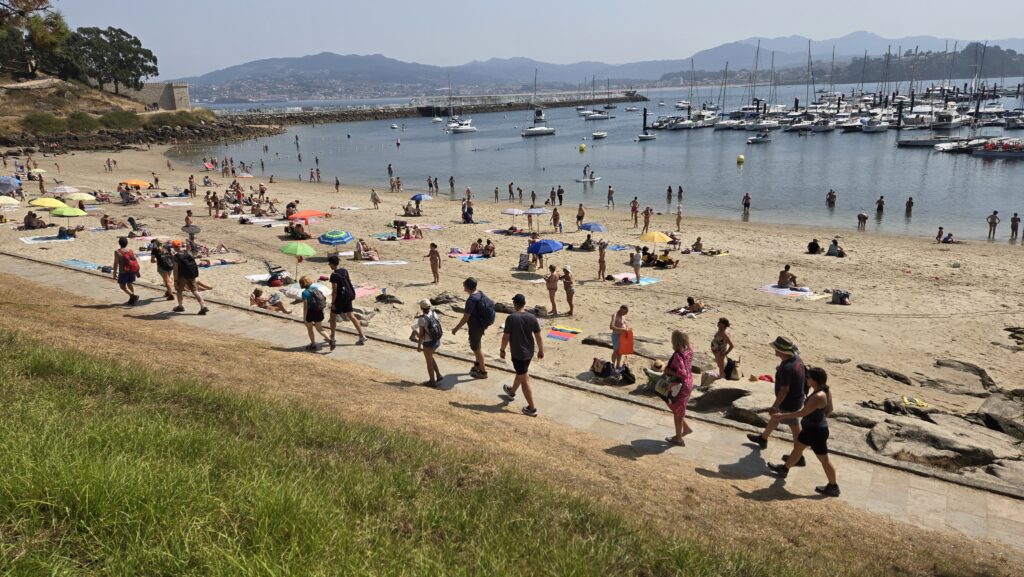
What's worth noting for anyone considering a move here is that Galicia's social infrastructure has two layers, and both matter.
The first is environmental: walkable streets, local markets, neighborhood bars, shared outdoor spaces that create the conditions for organic connection.
The second is intentional: communities, gatherings, and ecosystems that help internationally minded people find each other and integrate into something real rather than floating on the surface of a new place.
The cities that lose their social fabric tend to lose both. Galicia still has the first, and the second is quietly being built.
If food and movement provide the foundation, community may be the factor that truly distinguishes longevity in Galicia from many other aging populations around the world.
What Longevity in Galicia Means for International Residents
This is where Galicia's longevity story becomes relevant for people considering a move to Spain.
Longevity in Galicia has become part of a broader conversation about what a sustainable life actually looks like, one that more internationally minded people are starting to find personally relevant. What makes longevity in Galicia particularly relevant for international residents is that it reflects the same qualities many people are actively searching for when considering a move abroad.
Most relocation decisions begin with practical comparisons: cost of living, weather, taxes, healthcare, internet speeds, or visa requirements. Those factors matter, and they should absolutely be part of the conversation. But they don't fully explain why some people thrive after moving abroad while others continue searching for something they can't quite define.
As someone who has rebuilt my own life in different countries and spent years living as a digital nomad, I've learned that successful relocations rarely come down to a spreadsheet.
The people who seem happiest in the long run aren't necessarily the ones who chose the cheapest city, the lowest tax rate, or the place with the most sunshine. They're the ones who found an environment that supports the way they actually want to live.
What many people discover after arriving is that the benefits extend beyond the obvious. Daily life becomes easier in small but meaningful ways. Commutes shrink or disappear entirely. Outdoor spaces become part of everyday routines rather than something reserved for weekends. Relationships often deepen because life leaves more room for them. The constant feeling of rushing from one obligation to the next begins to soften.
Perhaps that's why so many people who initially focus their search on Madrid, Barcelona, Valencia, or Málaga eventually find themselves exploring Galicia. In fact, we've explored this idea in our article on where to live in Spain, where the best city isn't necessarily the most famous one.
The same pattern appears among founders and remote professionals. Increasingly, they're prioritizing focus, sustainability, affordability, and quality of life over prestige or proximity to major financial centers. It's one reason why more entrepreneurs are quietly moving to Galicia and building businesses from a region that offers something many larger cities struggle to provide: balance.
What Galicia's Centenarians Can Teach Us
The lesson that longevity in Galicia offers isn't a secret formula for living forever.
The lesson is that many of the things modern society treats as luxuries were once considered normal.
Time outdoors.
Strong communities.
Home-cooked meals.
Daily movement.
Connection to nature.
A sense of belonging.
Meaningful relationships.
Purpose.
These are the same qualities that repeatedly appear in discussions about healthy aging, quality of life, and long-term well-being.
Perhaps that's why Galicia's longevity story resonates with so many people.
It reminds us that a good life is often built from ordinary things repeated consistently over time.
And for people considering a move here, that's worth paying attention to.
Because the real story isn't that some Galicians live to 100.
It's that many of them spend decades living in a way that makes those years worth having.
Ultimately, longevity in Galicia is less a story about age and more a story about environment, relationships, and everyday life.
Thinking About Life in Galicia?
If you're exploring whether Galicia might be the right fit for your next chapter, our Complete Guide to Moving to Galicia is a great place to start.
If housing is one of your biggest concerns, you may also find our guide on finding housing in Spain covers the realities nobody warns you about.
And if you'd like clarity on your specific situation, our Discovery Consultation is designed to help you evaluate your options, understand the realities of life in Galicia, and build a practical roadmap for your move.
You don't need to figure it all out alone.
Is Galicia a Blue Zone?
Galicia is not officially classified as a Blue Zone. However, research into longevity in Galicia has identified exceptional centenarian concentrations that are attracting growing attention from researchers studying healthy aging.
Why do people live longer in Galicia?
Research on longevity in Galicia points to a combination of factors: strong community ties, daily movement, access to nature, lower stress levels, and dietary patterns associated with the Atlantic Diet.
What is the Atlantic Diet?
The Atlantic Diet is the traditional eating pattern of northwestern Spain and Portugal. It emphasizes seafood, vegetables, legumes, whole grains, olive oil, and seasonal local ingredients.
Is Galicia a good place to retire?
For many retirees, Galicia offers affordability, strong healthcare infrastructure, natural beauty, walkable communities, and a slower pace of life that supports long-term well-being.
What makes Galicia different from other parts of Spain?
Galicia combines Atlantic landscapes, strong social traditions, lower population density, access to nature, and a lifestyle that often prioritizes quality of life over speed and constant growth.
