By Patricia Cedeño.
You already have a property in Zurich, Utrecht, or Copenhagen that works. The tram arrives when the app says it will. The parental leave is generous, the pension makes sense on paper, and the whole country hums along without asking much of you.
And yet you're reading about Spain.
That's the part the people around you don't quite get. Your friends hear “northwest Spain” and picture a holiday, a cheaper version of what you already have. You know it's not that. You're not trying to downgrade your life. You're wondering whether the thing you've been optimizing for, efficiency, predictability, a very well run country, is the same thing you want from the next ten years.
If you're seriously considering moving to Galicia from Europe, and specifically from one of its most livable countries, you're asking a different question from the person escaping a struggling economy. You're not leaving something broken. You're leaving something that works, which makes the decision harder and a lot more honest.
So this isn't a case for Galicia, and it isn't a case against it. It's a look at what the exchange demands and what it gives back, with Vigo as the city where I'll make it concrete.
What Moving to Galicia From Europe Really Changes
Here's the shift in one sentence: you're leaving a country where the system carries the weight for a place where people carry more of it.
In Switzerland, Germany, the Netherlands, Austria, Belgium, or the Nordics, a huge part of daily life runs on institutions you never have to think about. Trains, permits, schools, waste collection, healthcare, all of it designed so your attention can go somewhere else. That's a real luxury, and you've probably paid for it with high taxes and long working weeks without ever calling it one.
Moving to Galicia from Europe means giving up some of that invisible reliability in exchange for something harder to measure: a daily rhythm where the unit of organization is closer to the neighbor, the shopkeeper, and the family table. Things do work here. They just work through people more often than through process.
The pattern I notice in conversations with people arriving from Zurich, Utrecht, Hamburg or Aarhus is that the first question is rarely “is it cheaper?” It's quieter than that. It's “will I miss the order?”
Three exchanges sit underneath almost every one of those conversations: efficiency for rhythm, predictability for human contact, and the life you know for the one you haven't tried yet. This article takes them in turn, then asks where Vigo fits.
The Money Question Behind Moving to Galicia From Europe
Some of you are still earning, some are retired, some run a business that goes wherever you go, and some simply aren't counting the days to the end of the month. The money question looks different for each of you, so let's start by dropping the one assumption that doesn't apply to everyone: the payslip.
If you plan to work for a local employer, the gap is worth knowing. According to Eurostat figures reported by Euronews, average annual net earnings in the Netherlands sit around €47,892, while Spain's sit around €24,571. Switzerland, in an earlier Euronews report, tops the continent at roughly €85,582. Those are averages, but if your plan after moving to Galicia from Europe is local employment at local pay, expect a different income picture.
And many people who make this move aren't replacing a Dutch salary with a Galician one. They bring a pension, a business, remote clients or savings, and the question becomes less about replacing an income and more about what that income allows your life to look like here. Tax, social security, and residency rules can all shape the real figure, and they depend on your passport, your situation, and how your income is structured, so they deserve proper professional input before you build a plan around any number.
What You Exchange: Systems, Health, and Movement
Process for people
The biggest difference shows up in administration. Spanish procedures tend to run on appointments, in-person visits, and original documents, and the person across the desk can change how smoothly things go. That's the exchange in miniature: less process, more people.
If you're from Germany or Switzerland, you may feel this one in your body. A folder with copies of everything and a few words of Spanish will do more for you than perfect preparation. Whatever your passport, moving to Galicia from Europe means accepting that some things will take longer and feel more human than you're used to.
Healthcare, and the assumption it quietly challenges
In 2024, Eurostat reported Spain's life expectancy at 84.0 years, among the highest in the EU. According to Eurostat figures covered by The Local, that puts Spain above Austria (82.1), Denmark (82) and Germany (81.2), and only a fraction behind Switzerland (84.2).
Galicia sits near the top of Spain on longevity too. According to INE data reported by EFE, the region had about 59.5 people aged 100 or older per 100,000 residents in January 2024, against a national average of about 34.8.
Life expectancy isn't a verdict on any single hospital. Diet, walking, social ties, and climate all feed into it. But it does challenge a quiet assumption: that higher national income automatically means a better everyday health experience.
The reality is more textured. Access to public care depends on your status and how you're registered. Waiting times for specialists or non-urgent procedures can be a genuine point of friction, and they vary by region and specialty. Many households combine public care with private insurance for speed and choice. When you're moving to Galicia from Europe, the useful question isn't which system ranks higher. It's how you would want to use each one.
Movement, walking, and distance
Movement is where moving to Galicia from Europe tends to surprise you in a good way. Much of central Vigo is built for walking. Groceries, cafés, the port, and the ferries sit close enough that living downtown without a car is entirely realistic, and for many residents it's a benefit rather than a compromise. The Dutch tend to ask about bikes. Vigo's hills make cycling a different sport from Utrecht, but a dense center may mean you hardly miss it.
Long distance is where it helps to be specific. A high-speed train reaches Madrid in roughly four hours, and Vigo's own airport has seen international routes come and go with the seasons, so you may connect through Madrid or Barcelona, or fly from Santiago de Compostela or Porto. If your life involves a monthly trip to Frankfurt, Amsterdam or Oslo, check current routes early. The upside is a city that isn't organized around departures. It's organized around being home.
The Part Nobody Puts in the Spreadsheet
The social side of moving to Galicia from Europe is harder to quantify than a budget, so let's talk about it directly.
Northern and Central European societies tend to be built around individual autonomy. You respect each other's space. You make plans in advance. You don't turn up unannounced. A friendship may take a while to begin, and once it does, it's reliable. It's a social model with a lot of dignity, and also, if you're honest, one that can feel isolating for the people who live inside it.
Galicia runs on a different clock. The long lunch isn't a luxury, it's the infrastructure. Neighbors talk to you in the stairwell. The person at the fish counter has an opinion about what you should cook and will share it. Families sit at the center of social life, and the friend circles of many locals have existed since school.
That last point matters. If you arrive expecting to be swept into a warm, open social scene, you may find that warmth comes quickly but depth takes time. It's not coldness. It's the opposite problem: the table is already full, and you're learning where your chair goes.
The people who settle well after moving to Galicia from Europe tend to do two things. They learn enough Spanish to have a real conversation, and they show up repeatedly in the same places until they become a face rather than a foreigner. A café, a market, a running group, a language exchange that turns into dinner.
Language is a real adjustment for you in particular. You're used to countries where almost everyone speaks excellent English. In Galicia, many people speak some English, and many don't, and Galician sits alongside Spanish in daily life. Expect to work at it. Expect it to be worth it.
Trying to work out whether Galicia could actually work for you?
If you're still in the early stages, the research behind moving to Galicia from Europe can start to feel endless. Every answer opens two new questions, and none of them is about Galicia in general. They're about your rhythm, your plans, and your idea of a good week.
The free Galicia Relocation Guide is built for exactly that stage. It walks through the lifestyle, the culture, the pace, the regions, housing, and the realities of living here, so you can judge whether Galicia fits before you spend a euro on anything else.
Where Vigo Fits When You're Moving to Galicia From Europe
Here's the tension underneath all of this. For anyone moving to Galicia from Europe, the picture is rarely a village. Someone coming from Utrecht, Zurich, or Aarhus doesn't usually want to swap a highly functional city for a tiny coastal village. You may love the idea of the village for a weekend. For a Wednesday in February, with a dentist appointment, a client call and a grocery run, you want something else.
What you're really after is a combination that's surprisingly hard to find: city infrastructure, access to the Atlantic, a slower rhythm and a daily life where Spanish, and in Galicia, Galician, becomes part of the experience. That's where Vigo becomes interesting. Not because it's better than where you live, but because it occupies a middle ground that a village, or a bigger and busier Spanish city, doesn't.
City infrastructure without the city fatigue
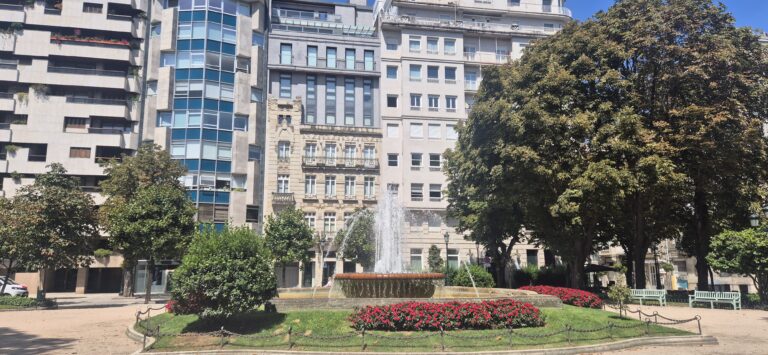
Vigo is Galicia's largest city by population, a working port with a university, major hospitals, an airport, a rail link to Madrid and ferries across the ría. Your daily errands can happen on foot in much of the center. There are markets, cinemas, cafés, specialist shops and the kind of services you would miss in a smaller place.
But it doesn't feel like a city performing itself. The Casco Vello, the old granite town, is lived in rather than preserved. The Berbés fish market and the oyster stalls beside it exist because people still eat there, not because visitors expect a photo. If you're moving to Galicia from Europe because a polished, overmanaged city started to feel thin, this texture is a big part of the answer.
The Atlantic as part of the week
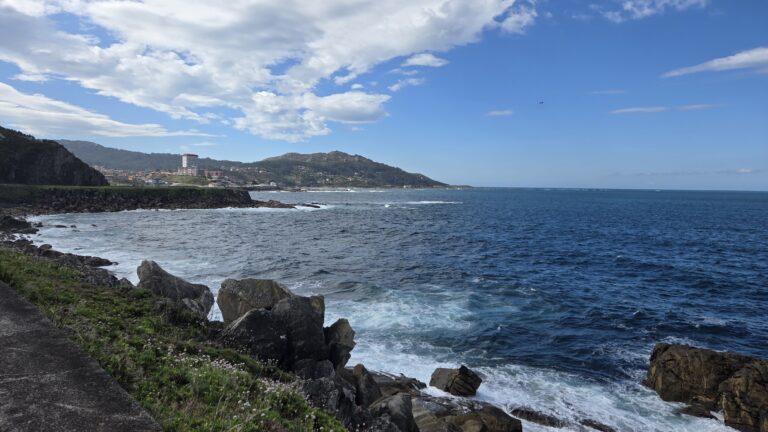
In a lot of European cities nature is an organized weekend trip. Here it's closer to the edge of the day. You can swim at Samil, take a boat to the Cíes Islands in season, or cross to Cangas or Moaña on a commuter ferry that locals use to get to work. In many parts of the city you can usually get fast fiber, so a morning walk by the water and a video call at nine can live in the same day.
The Atlantic isn't scenery here. It's a presence in the weather, the food, the light, and the way people talk about their day.
A slower rhythm, still a real city
Vigo's neighborhoods are organized around a plaza, a bakery, and a bar where they know your order by the second week. The city has a serious food culture, a football club that matters to people, and a famously over the top Christmas lighting tradition that tells you something about how Vigo sees itself: proud, a little theatrical, and not trying to be anyone else.
There's also a quieter point if you're moving to Galicia from Europe to integrate rather than observe. Vigo's international community is smaller and less formed than in Barcelona or Valencia. If you're looking for an established international bubble, that's a limitation. If you're looking to integrate into a Spanish and Galician daily life rather than recreate the international city you've left, it can be an advantage.
What Vigo asks of you
Choosing Vigo when moving to Galicia from Europe asks you to be at ease with a city that isn't polished. Parts of Vigo are rough around the edges, and its identity as an industrial port is still visible. It asks you to accept that it rains often and that winter is gray in a way you may know from northern Germany but will notice again. It asks you to make peace with hills, with the airport question, and with a pace that doesn't rush to meet your expectations.
It also asks you to be a little curious about what Vigo is becoming. Over the past few years there has been visible momentum in design-led hospitality, restored heritage buildings, and a growing international presence. That's interesting if you like being early to something and unsettling if you wanted a finished place.
I'm not telling you Vigo is better than where you live. For some people it won't be the right fit at all, and I'd rather say that now than watch you find out in month eight.
The Three Year Test for Moving to Galicia From Europe
Here's the question that sorts most decisions in this category: the first year tests your enthusiasm, and the third year tests the place.
In year one, everything is new and the newness does the work. The seafood is a revelation, the light is extraordinary, and every small inconvenience becomes a story you tell friends back home.
By year three, the novelty is gone. What's left is your actual life: your work rhythm, your friendships, your relationship to the language, your patience with paperwork, your comfort being far from the family you left. Moving to Galicia from Europe works when those quiet, repeated parts of life improve, not just when the first few months feel exciting.
A useful way to test yourself is to picture a specific, unremarkable week in year three. You have a deadline on Thursday, the rain has been constant, a document needs an appointment you can't get until next month, and your closest friend from home isn't within a two hour flight. Do you still want to be here?
If the answer is yes, and you're a little surprised by how yes it is, that's a strong signal. If it's “only if the weather is good and everything runs smoothly,” that's a signal too.
Who Moving to Galicia From Europe Suits, and Who Should Look Elsewhere
Galicia isn't for everyone, and I'd be doing you a disservice if I pretended otherwise.
Moving to Galicia from Europe tends to suit you if your income, pension, or business travels with you, if you value a daily rhythm that lets you walk, eat and see people more than you value fast systems, and if you're comfortable being a beginner again in language and in social life.
It may not suit you if your career depends on being physically close to a major European hub, if you need dependable English everywhere, or if a slow administrative process fills you with dread rather than curiosity. In those cases, another part of Spain, or another country altogether, may serve you better. Moving to Galicia from Europe is not a promotion. It's a different set of priorities.
Still unsure whether Galicia belongs on your shortlist?
You've read about what you gain, what you give up, and the questions only you can answer. If you're seriously considering a move to Galicia in the next year or two, a Relocation Clarity Consultation is where we look at what your move would actually involve, what you're looking for in a place to live, which parts of Galicia could fit, your timeline, housing needs, and the practical decisions that need to happen between “we're thinking about it” and “we're moving.”
We'll look at where Vigo fits, what other parts of Galicia might make sense, and what needs to happen first, next, and later as you plan your move.
The goal isn't to give you another list of information. It's to help you see your move more clearly and understand what the next steps could look like.
And if your answer turns out to be somewhere else in Spain, I'll tell you that too.
Book Your Clarity Consultation →
Is moving to Galicia from Europe's wealthier countries a financial downgrade?
It depends on your situation. If you take local employment at local pay, your income will likely be lower than in Switzerland, Germany or the Netherlands. If you bring a pension, a business, remote clients or savings, the question becomes what that income allows your life to look like here. Tax, social security and residency rules can affect the real figure, so get proper advice for your own situation.
Do I need a visa if I'm moving to Galicia from Europe as an EU or EEA citizen?
As an EU or EEA citizen you generally don't need a visa to live in Spain, but there are registration steps to complete after arrival. Swiss citizens are covered by a separate agreement, so the details can differ. Always confirm your specific requirements with the relevant Spanish authority or a qualified professional before you move.
How different is daily life in Vigo from Zurich, Amsterdam or Hamburg after moving to Galicia from Europe?
The pace and the social texture are different. Vigo is walkable at neighborhood scale and closely tied to the Atlantic, but it's less polished, rainier and slower with administration. English is less widely spoken than you may be used to, so learning Spanish makes a real difference.
Will I need a car after moving to Galicia from Europe?
It depends on where you live in Vigo and how often you leave the city. Many people living in the center get by comfortably on foot, with public transport and ferries covering a lot of ground. If you plan to live outside the center or explore the wider region often, a car can be useful.
What about flights home after moving to Galicia from Europe?
Vigo's airport has had a changing mix of routes, so check current service before you plan. You may connect through Madrid or Barcelona, or use the airports in Santiago de Compostela or Porto. If frequent travel to a European hub is essential to your work, solve that before you commit.
How long does it take to feel settled after moving to Galicia from Europe?
It varies widely. Many people describe the first year as discovery and the second and third years as the real test of whether the place fits their life. Language, local friendships, and how you handle administration tend to shape how settled you feel.
The Galicia Life is a community and relocation ecosystem based in Vigo, Spain, working at the intersection of intentional living, cultural integration, and relocation support for internationally minded people building real lives in Galicia.