
By Patricia Cedeño.
For years, the relocation path looked predictable.
You decided you wanted to live in Europe. You researched Spain. You looked at Madrid for the career infrastructure and the city energy. You looked at Barcelona for the coast. Maybe Valencia made the list if you wanted something slightly more affordable. You started the visa process. You began looking at apartments in one of those three cities.
Increasingly, Americans are doing all the research on those cities and ending up somewhere else entirely.
Americans moving to Spain are discovering that the biggest decision is no longer whether to move, but where.
The Shift Is Already Happening
One thing I've noticed consistently is that Americans moving to Spain rarely contact me asking about Galicia first. They usually arrive after researching Madrid, Barcelona, Valencia, or Málaga. They've compared the climates, run the cost calculations, read the forums, and often visited one of the obvious cities on an exploratory trip.
Galicia enters the conversation later. Usually around the moment someone stops asking where Americans are moving and starts asking where they would actually enjoy building a life.
That shift happens at different moments for different people. Sometimes it's the moment they realize a one-bedroom in Chueca costs what they were paying in Austin. Sometimes it's after the first visit to Barcelona and the feeling that it's simultaneously beautiful and exhausting. Sometimes it's a slower realization that the life they're imagining doesn't actually require a city of that scale, and maybe never did.
What I've seen, both in direct conversations and in the broader pattern of inquiries coming through, is that the profile of an American looking seriously at northern Spain has changed. Two or three years ago, it was mostly people who had been here before or who had a specific connection to the region. Now it's people who started their research in Madrid and worked their way north through the research process and discovered something they weren't expecting.
What many Americans discover during this process is that they aren't actually looking for a different country. They're looking for a different relationship with their time.
And once that becomes the goal, the map of Spain starts to look very different.
The Numbers Behind the Move
As of 2024, Spain is home to around 41,000 US citizens according to Spain's National Statistics Institute, a number that rose 13% between 2019 and 2023. The real figure is likely higher, as many Americans live in Spain without officially registering.
The question of where Americans moving to Spain actually land once they look past the obvious cities is one the headline numbers rarely answer.
The drivers are well documented. Spain's cost of living runs roughly 40% lower than the US without rent, and housing costs can be 50 to 70% less outside Madrid and Barcelona. For a growing number of Americans, the move to Spain is no longer a distant aspiration. It's a near-term plan, with visa paperwork already in progress and apartment searches underway.
What the headline numbers don't show is where within Spain people are actually landing once they look past the obvious.
Madrid and Barcelona remain the most expensive cities for international arrivals seeking an urban lifestyle. Meanwhile, regions like Galicia or Asturias provide more affordable and authentic alternatives. That framing — more affordable and authentic — used to feel like a consolation prize. Increasingly, for a specific kind of American, it's the goal.
What the Obvious Cities Actually Cost Now
The appeal of Madrid and Barcelona is real. Both have large established American communities, English-speaking infrastructure, and the kind of legibility that makes the first months of life abroad manageable. That matters, especially for people making this move for the first time.
What they also have, in 2026, is a price point that has quietly narrowed the gap with the cities many Americans just left.
Madrid and Barcelona city center one-bedroom apartments run €1,315 to €1,436 per month. In neighborhoods with the kind of character that drew people to these cities in the first place, like Malasaña, Gràcia, and El Born, where the numbers climb higher. Monthly living costs for solo living in Madrid and Barcelona can exceed €3,000 when rent, services, and daily expenses are combined.
For American retirees on fixed income, families with school-age children, or founders trying to extend their runway while building something new, that structure creates a version of European life that looks better on paper than it feels in practice. The financial relief they were expecting exists, just not always at the scale that changes how daily life actually feels.
That tends to be the moment Galicia enters the conversation for Americans moving to Spain who expected more.
The Visa Framework That Changed Everything
These pathways have created something that didn't exist a decade ago: a large population of Americans with genuine freedom to choose where they live, not just where their employer or their budget forces them.
The Spain Digital Nomad Visa enables remote employees and freelancers to live in Spain while working for non-Spanish companies, requiring a minimum monthly income of around €3,000. The Beckham Law caps income tax at a flat 24% on earnings up to €600,000 for up to six years, a tax structure that changes the financial calculus of the move significantly for high earners.
The Non-Lucrative Visa, for those with passive income, requires around €2,400 per month and leads to permanent residency.
Both pathways attract Americans moving to Spain with established income and the ability to choose where they live based on quality rather than necessity. When you have that freedom, the question of where becomes more interesting and more personal than the standard relocation guides tend to acknowledge.
Beginning in late 2026, all Americans visiting Spain will need ETIAS authorization before arrival, even for short stays, at a cost of €20 valid for three years. For those planning a move, this is an administrative detail rather than a barrier.
Why Americans Moving to Spain Are Looking North
For Americans looking for greenery, cooler weather, and a slower pace, Galicia, Asturias, and the Basque Country offer scenic landscapes, lower costs, and tight-knit local communities.
Americans moving to Spain on the Digital Nomad Visa or Non-Lucrative Visa have genuine freedom to make that choice, and increasingly, they're using it.
What that summary doesn't capture is the texture of why people end up there.
The Americans who make it to Galicia are rarely the ones who started their research there. They're the ones who went through the full process of understanding what Madrid and Barcelona cost and what they offer and then asked a harder question: Is the life available in those cities actually the life I'm trying to build? For a growing number, the honest answer is no.
In southern Spain, Galicia, and smaller cities, one-bedroom apartments run €443 to €641 per month, often less outside historic or tourist cores. That's not a marginal difference from Madrid or Barcelona. It's a different financial architecture, one that changes what you can build, what risks you can take, and how much of your income goes toward simply existing in a place rather than living in it.
Beyond cost, there is something harder to quantify but consistently mentioned in the conversations I have: the social environment feels different. The international layer exists in Galicia but doesn't dominate. The community takes longer to enter and goes deeper once you're in it. The relationship between local and international residents is more mixed, and ultimately more satisfying for people who came to Spain to actually live in Spain.
What Galicia Offers and What It Doesn't
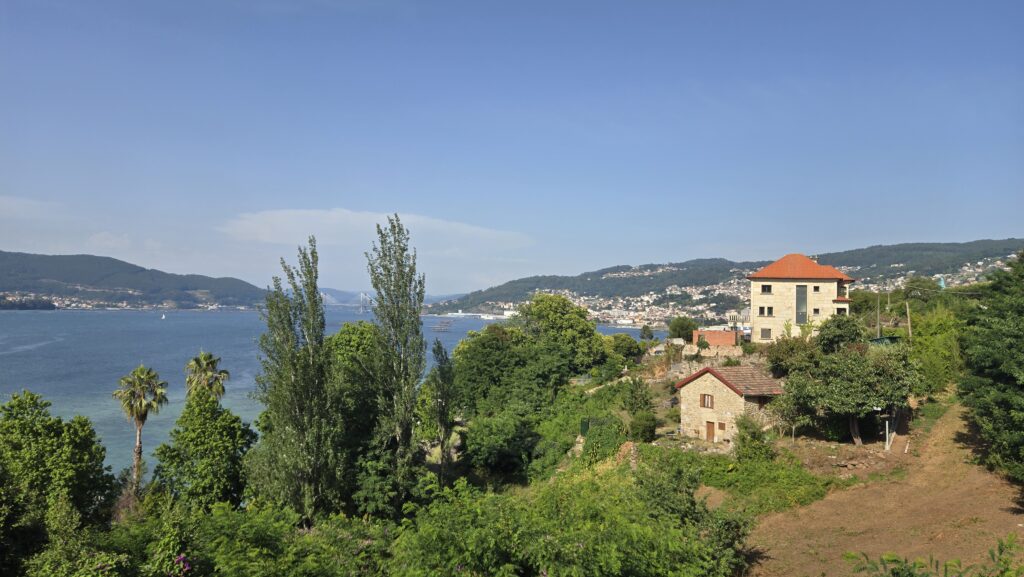
For Americans moving to Spain who make it past the obvious options, Vigo tends to be where the search ends. It is the largest municipality in Galicia, with a metropolitan area approaching 500,000 people. It has the infrastructure of a real city, a modern hospital, a university, a functioning port economy, and fiber internet that reaches rural areas, combined with a cost of living and a pace of daily life that the obvious cities cannot match at any price point.
A one-bedroom in Vigo's city center runs €550 to €715 per month. The Cíes Islands, one of the most protected archipelagos in Europe, are a ferry ride away. Porto Airport, under an hour south, connects to over 134 destinations in 34 countries.
But Vigo isn't for everyone. The weather is wetter and greyer than in southern Spain: Atlantic, variable, and occasionally dramatic. The international community is smaller and takes more effort to find. The English-speaking infrastructure that makes Madrid or Barcelona immediately navigable doesn't exist here at the same scale. Integration takes longer, requires more Spanish, and rewards patience in a way that not every profile is prepared for.
Galicia tends to attract three profiles repeatedly: retirees looking for a comfortable long-term base, founders and remote professionals seeking more margin and flexibility in their lives, and families prioritizing safety, outdoor access, and quality of life over proximity to a large international community.
But for the American who needs immediate social legibility, direct long-haul flights from the doorstep, or finds grey winters genuinely difficult, Galicia will test them. Knowing that before you arrive is more useful than discovering it in February.

What the First Year Actually Looks Like for Americans Moving to Spain
The research phase and the lived experience are different things, and the gap between them catches people off guard more often than it should.
Most Americans moving to Spain spend the first few months managing logistics they didn't fully anticipate.
Getting a bank account takes longer than expected; most Spanish banks require an in-person appointment, a NIE number, and patience that isn't always easy to find when you've just arrived in a new country. Registering on the padrón, which is the municipal census that unlocks access to local healthcare and services, requires a rental contract. Getting a rental contract often requires the NIE. The NIE requires an appointment that may be weeks out. This circular sequence isn't impossible to navigate; many thousands of Americans have done it, but it tends to consume the first six to eight weeks in a way that nobody's relocation timeline accounts for.
What I consistently tell people at the start of this process is that the practical sequence matters as much as the destination choice. The order in which you do things, from visa approval, NIE, bank account, and housing to padrón registration and healthcare enrollment, has a correct version and several incorrect ones, and getting it wrong costs time and sometimes money at a moment when both feel particularly scarce.
What happens after that phase is usually where the experience shifts. The logistics settle. The neighborhood becomes familiar. The café where the staff recognize you starts to feel like something. The market becomes a Tuesday routine rather than an occasion. For most Americans moving to Spain who make it through the first few months intact, there's a specific moment, different for everyone but consistently described, where the life they were imagining starts to feel like the life they're actually living.
In Galicia, that moment tends to arrive more quietly than in Madrid or Barcelona. There's no dramatic city energy to signal that you've arrived somewhere interesting. The shift is more internal: the realization that your day has slowed down in a way you didn't engineer, that you're spending more time outside without planning it, and that the people around you seem less rushed than you remember people being anywhere else. It's a subtle recalibration, and it tends to produce something more durable than the initial excitement that drives most moves abroad.
The Americans who do best here are usually the ones who came prepared for that transition rather than surprised by it. They arrived with realistic expectations about the logistics, a short-term housing base already sorted, some Spanish already underway, and a plan for building community deliberately rather than waiting for it to happen automatically. None of that is complicated. But it requires thinking about the first year as something to design rather than something to endure.
A Different Question
The Americans arriving in Galicia aren't choosing the region because it's hidden or because they stumbled across it.
They're choosing it because, after months of research, Americans moving to Spain have become less interested in where everyone else is going and more interested in where they can build a life that actually fits. That's a different question. And it often leads to a different answer.
If you've reached the point where you're comparing regions instead of countries, you're asking better questions. That's usually when Galicia enters the conversation.
The Complete Guide to Moving to Galicia covers the practical reality in detail: visa pathways, costs, neighborhoods, healthcare, and integration. If you've already compared the obvious options and want the numbers side by side, the Vigo vs Lisbon, Valencia and Porto comparison goes into that directly.
Research can tell you what a place costs. It can't tell you what it feels like to build a life there.
That's why The Galicia Life exists.
Some people start by joining the free community and learning from others who have already made the move. Others reach a point where they want to talk through their specific situation, priorities, and options.
If you're at that stage, I'd be happy to help.
Can Americans move to Spain in 2026?
Yes. Americans moving to Spain have two main long-term pathways: the Digital Nomad Visa for remote workers, requiring around €2,850 per month, and the Non-Lucrative Visa for passive income holders, requiring around €2,400 per month. Both offer pathways to permanent residency.
How much money do Americans need to live in Spain?
A retired couple with a $60,000 annual income can live very comfortably in most Spanish cities. In Galicia specifically, costs run significantly lower than in Madrid or Barcelona since a one-bedroom in Vigo's city center runs €550 to €715 per month, and a couple can live well on €1,800 to €2,200 per month, including rent.
Is northern Spain a good option for Americans moving to Spain?
Yes, and it's consistently underrepresented in most relocation guides. Galicia, Asturias, and the Basque Country offer lower costs, Atlantic landscapes, and communities that tend to reward longer-term integration over immediate social access. The tradeoffs are real: wetter weather, smaller English-speaking infrastructure, and slower social entry are worth understanding before you decide.
What is the Beckham Law and does it apply to Americans moving to Spain?
The Beckham Law caps income tax at a flat 24% on earnings up to €600,000 for up to six years for qualifying arrivals. Combined with the US-Spain tax treaty and Foreign Tax Credit, which typically eliminate US tax liability for Americans paying Spanish taxes, it can make the overall tax position significantly more favorable than staying in a high-tax US state.
Why are Americans choosing Galicia over Madrid or Barcelona?
For Americans moving to Spain, the conversation usually starts in Madrid or Barcelona and moves to Galicia once the cost structure of the obvious cities becomes clear and the question shifts from “where is everyone moving?” to “where would I actually enjoy living?” Galicia offers lower costs, a pace of life that feels genuinely different, and a social environment that rewards integration rather than simply providing access to a ready-made international community.
Is Vigo a good city for Americans?
For the right profile, yes. Vigo is the largest municipality in Galicia with a metropolitan area approaching 500,000 people, modern healthcare infrastructure, reliable fiber internet, and a cost of living dramatically lower than Spain's major cities. It suits remote professionals, retirees, families, and founders. It asks more of you in terms of language and integration than Madrid or Barcelona and tends to give more back over time.
The Galicia Life is a community and relocation ecosystem based in Vigo, Spain, working at the intersection of intentional living, cultural integration, and relocation support for internationally minded people building real lives in Galicia.
