By Patricia Cedeño.
The first version of remote work sold a very specific fantasy: laptop on a beach, a new city every few months, a life free of any single place. It worked for a while. Then something started to shift underneath it. That kind of life is easy to leave, and almost impossible to build anything real inside of.
That shift helps explain why digital nomads in Vigo represent a different side of the remote-work conversation. The city isn't competing to become another Lisbon, another Bali, or another stop in the cheap-fast-fun cycle. Its appeal is growing among location-independent professionals who could live almost anywhere and are becoming much more selective about where a temporary move might become a permanent life.
Vigo is increasingly well positioned for that transition. It's a working Atlantic port city on Spain's northwest edge, without a coworking space on every corner or an English-first infrastructure, but with the ingredients that start to matter when choosing somewhere for years rather than months.
This is a long, honest look at why Vigo is becoming relevant to remote professionals ready to stay, what the city offers once the novelty of arrival wears off, and where building a life here is genuinely still hard.
Why “Digital Nomad Hub” Is Becoming the Wrong Category
A lot of the writing about remote work in Spain still treats it as a single race for the same audience: young freelancers, low cost of living, Instagrammable cafés, a rotating international crowd that stays six weeks and leaves. Those places exist. Some of them are great for what they are.
But an interesting shift is happening somewhere else. For location-independent professionals who have already experienced the freedom of working from almost anywhere, a harder question eventually emerges. Not simply ‘where's cheap and fun,’ but where they'd still want to be in three years, when the novelty has worn off and they need a doctor, a school, a favorite baker, and someone to have dinner with on a Wednesday.
That's a completely different filter, and it changes which destinations remain interesting. Vigo begins to make sense when the goal is no longer finding the easiest place to spend six months but choosing a city capable of supporting the next five or ten years of your life.
What Everyday Life in Vigo Actually Makes Possible
The appeal becomes clearer when you stop looking at Vigo as a destination and start looking at the structure of everyday life.
This is a compact working city where the market, waterfront, cafés, offices, shops, and residential neighborhoods exist alongside one another rather than inside separate tourist and business districts. Depending on where you live, a workday can include focused hours at home or from a coworking space, errands completed on foot, lunch without crossing the city, and access to the coast before or after work.
That matters more than it sounds. One of the hidden costs of living in a major international hub is the amount of time and energy required simply to participate in it. Long commutes, expensive housing far from the center, constant professional events, and social circles that change as quickly as people arrive can gradually become part of the price of opportunity.
Vigo offers a different trade. It has less international infrastructure and fewer ready-made professional networks, but everyday life can operate at a more manageable scale. You begin seeing the same faces. Relationships have time to repeat. The city becomes familiar.
That either feels limiting or like the exact thing you've been missing. Which side of that line you fall on tells you a great deal about whether Vigo would work for you.
The Bigger Shift: From Mobility to Permanence
Spain's Digital Nomad Visa changed the relocation conversation because it gave eligible non-EU remote workers a legal pathway to base themselves in the country while continuing to work internationally. But the more interesting shift goes beyond the visa itself.
Location independence is maturing. Once you've proven that you can work from almost anywhere, the number of destinations available to you stops being the main advantage. The harder question becomes which place deserves your time, your relationships, your money, and eventually your commitment.
That changes how cities compete for internationally mobile professionals. Coworking spaces, fast internet, and affordable rent aren't enough on their own anymore. Someone considering a longer stay begins evaluating healthcare, housing, schools, transport, taxation, social connection, cultural fit, and whether the city still works when you're no longer experiencing it as a visitor.
This is where Vigo becomes interesting. It doesn't compete with Barcelona, Lisbon, or Málaga in the size of its international scene. Its advantage is different: the possibility of combining an international career with a functioning year-round city where becoming a resident doesn't require living permanently inside a transient international ecosystem.
The opportunity for Vigo isn't to attract more people who want to live everywhere. It's to become relevant to location-independent professionals who are finally ready to choose somewhere.
You can research a city for months and still arrive knowing no one.
That matters more when you're looking for somewhere to stay, not somewhere to spend a season.
The Galicia Life Community brings together international and local people building lives, projects, and relationships in Galicia. It's a place to understand the region through the people already part of it, make connections before you arrive, and start becoming part of the conversation rather than beginning from zero.
If Vigo is becoming more than another destination on your list, this is one way to start building what comes next.
What the City Actually Offers Digital Nomads in Vigo for the Long Haul
For digital nomads in Vigo, the long-term case depends less on novelty and more on whether the city can support the practical realities of everyday life.
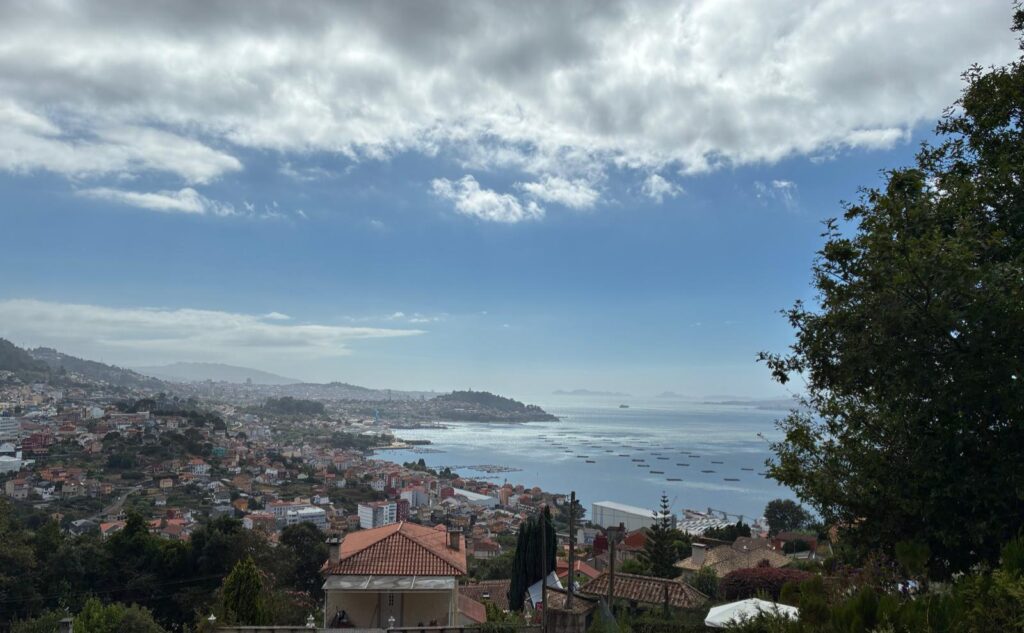
Vigo is a working city of around 295,000 residents, supported by its port, industrial economy, universities, healthcare infrastructure, commerce, and cultural life. The city functions primarily for the people who live and work here year-round rather than around a seasonal international population. You're not living in someone else's holiday backdrop.
Quality of life at a lower cost base than the cities you're probably leaving. Rents remain below what you'd pay in Madrid or Barcelona, let alone London, Toronto, or New York, though local demand is tightening (more on that below). Healthcare infrastructure is anchored by Hospital Álvaro Cunqueiro, part of the University Hospital Complex of Vigo, which serves a healthcare area of around 600,000 people. Private healthcare providers operate alongside the public system, while access to healthcare for international residents depends on immigration status, Social Security entitlement, private insurance, and individual circumstances.
Nature that's integrated into daily life rather than kept behind a weekend calendar. Monte O Castro and Monte da Guía rise inside the city itself and are walking distance from central neighborhoods. Beaches like Samil and O Vao sit along the urban coastline. The Cíes Islands are a short seasonal ferry ride from the port, though services concentrate between Easter and September. The wider Rías Baixas, wine country, coastal trails, and small fishing villages start just outside the city. None of this requires a special trip.
Access to three airports changes the connectivity equation. Vigo's own airport, operated by Aena, handles regular domestic routes, including Madrid, Barcelona, and the Canary Islands. Santiago de Compostela Airport, roughly an hour away by car, expands the European network and now adds a seasonal direct connection to New York. Porto's Francisco Sá Carneiro Airport, around 110 kilometers from Vigo and reachable by road or direct bus, provides an even wider range of European and long-haul connections, including direct flights to North America. For digital nomads in Vigo who travel internationally several times a year rather than every week, access to three airports creates a broader connectivity network than the city's size or location might initially suggest.
And, quieter but arguably more important, the possibility of relationships that aren't transient. This is the piece that quietly wrecks the classic nomad life for a lot of people around their tenth year of doing it. A place where you can actually know your barista, your neighbor, and your landlord and where those relationships aren't reset by the next flight is worth more than you realize until you've lived without it for long enough.
Where It Genuinely Gets Hard
None of this makes Vigo an obvious yes. If you're actually thinking about it, the friction points deserve the same honesty.
The international professional ecosystem here is still developing. Vigo doesn't have Madrid's density of English-speaking startups or Barcelona's mature international scene. What it has is a smaller, growing layer of location-independent professionals, some hospitality founders, and a handful of coworking and community spaces, all still finding their shape. If you need to be inside a large, ready-made international ecosystem from day one, you'll find yourself building it rather than joining it.
English-first infrastructure is limited. Everyday services, healthcare, bureaucracy, most of the professional world function in Spanish, with Galician woven through daily local life. It is possible to manage the early stages of relocation with limited Spanish, particularly with professional support, but building an independent life here becomes considerably easier as your language skills improve.
Integration takes effort you don't always have to spend elsewhere. In a big hub, the international scene comes to you. In Vigo, you have to go looking at language exchanges, at community events, at whatever the current small handful of internationally minded gathering spots turn out to be. That's a feature if you genuinely want to build something beyond an expat bubble. It's a bug if you want the ease of an off-the-shelf social life.
Housing is becoming more competitive. Advertised rents across Spain have risen sharply in the past year, and Galicia's larger cities are part of that broader pressure. Digital nomads in Vigo still benefit from lower housing costs than in many of Spain's major international hubs, but limited supply in sought-after neighborhoods and growing demand mean newcomers shouldn't assume that finding the right long-term rental will be effortless. If you want to think through the timing of a move alongside the housing question, the best time to relocate to Galicia piece goes into it in more depth
If you want to think through the timing of a move alongside the housing question, the best time to relocate to Galicia piece goes into it in more depth.
International connectivity, while genuinely usable via Porto, is more effort than a direct flight from a major hub. If your work requires last-minute intercontinental travel every few weeks, that's a real friction. If you fly two or three times a year to see family or clients, the Porto route is fine, and you'll stop noticing it.
When a Digital Nomad Stops Being a Nomad
The interesting thing about a working city like Vigo isn't only what it offers you on arrival. It's what starts happening when the question stops being ‘Does this place work for a season?’ and becomes, ‘Does this place work for a life?
For digital nomads in Vigo, that transition changes the decisions that begin to matter.
Housing decisions get longer. What made sense as a six-month rental with flexibility starts to matter differently when you're thinking about which neighborhood you'd still want to be in three years from now. The conversation shifts from “cheap and central” to schools, hospitals, quiet streets, a walk to the sea, and whether a particular building will keep you warm in February.
Tax planning becomes more important. Spending more time in Spain, establishing your main economic interests here, or changing where your family and everyday life are based can affect your tax residence and reporting obligations. International income, business structures, assets abroad, and applicable double-tax treaties all need to be reviewed in the context of your individual circumstances with a qualified cross-border tax professional.
Learning Spanish stops being a nice idea. The version of your life that runs entirely in English caps out at about the level of daily errands and expat friendships. Everything past that, real friendships with locals, being genuinely useful at a neighborhood association, and understanding what your gestor is actually telling you needs the language.
You choose neighborhoods differently because you're not optimizing for the Instagrammable street anymore. You're optimizing for a walk to the pharmacy, a café where the owner remembers you, and a rental you'd want to stay in when the novelty wears off.
Professional and social relationships start to compound rather than reset. This is the quiet thing that changes everything. In a nomad life, every relationship starts from zero every few months. Somewhere in the second year of choosing to stay, the same faces at the same places begin to add up to something.
For a smaller number of people, property purchase enters the conversation. That's a different article and a much longer decision, but it's worth naming because it's often what marks the actual transition from a remote worker who lives in Vigo to someone building a life here.
None of this happens automatically. But it's the shape of the transition that separates a stay from a chapter.
Vigo Is Becoming More International, and That Comes With Trade-Offs
International visibility is a mixed thing, and any honest article about digital nomads in Vigo has to sit with both sides of it.
More international attention can bring better direct flight connections, new businesses, expanded professional services, fresh investment, more cultural exchange, and stronger networks that make it easier for the next arrival. Some of that is already visible in the growth of coworking spaces, the arrival of a handful of international-facing cafés and hospitality concepts, and a slowly maturing conversation around what “quality of life migration” looks like from this corner of Spain.
It also brings housing pressure, more tourist accommodation, parallel expat ecosystems that don't integrate with local life, gradual loss of affordability, and businesses built to serve newcomers rather than the city itself.
The question isn't whether Vigo should become more international. That process is already happening. The more important question is whether the people arriving become participants in the city or simply consumers of it.
That distinction is the difference between a place that's still worth choosing five years from now and another destination that quietly becomes what it was trying not to be.
The Things You Can't Build Remotely
Remote work solved the question of where you need to be.
It didn't solve the question of where your life works best.
You can earn income from another country, manage a team across time zones, and maintain friendships through a screen. But you can't outsource the neighborhood you wake up in. The people you see regularly. The doctor you trust. The places where you're known. The distance between your front door and the kind of life you want to live.
Those things only become more valuable with time.
And perhaps that's the real advantage of being location-independent. Not the ability to keep moving, but the freedom to be unusually selective about where you eventually stop.
Seen that way, Vigo isn't competing with Lisbon, Barcelona, or the long list of cities designed to make arrival easy. The question is whether it can support the life that begins after arrival, when the novelty wears off, your routines become ordinary, and staying somewhere starts to mean becoming part of it.
That's a much harder standard for a city to meet.
It's also where Vigo becomes most interesting.
If you're no longer asking where you can work remotely and have started asking where you could build a life without giving up the career you've created, the relocation itself deserves the same level of thought.
Choosing Vigo is only the beginning. Where you live, when you move, how you approach the housing search, which local professionals you need, and how those decisions fit together will shape your first years here. A Discovery Consultation helps you turn those moving parts into a clearer relocation plan before expensive decisions become urgent.
If you're still deciding whether Galicia fits the life you're looking for, the Complete Guide to Moving to Galicia explores the wider realities of living here. And if you want to start building connections before you arrive, The Galicia Life Community is where international and local people exchange experiences, ask questions, and build relationships around life in Galicia.
Is Vigo a good base for remote workers considering a long-term move?
It depends on what you want from the experience. If you're looking for a large, established international nomad scene with English-first infrastructure and non-stop intercontinental flights from your doorstep, cities further south are a better fit. If you want a functioning year-round city with a lower cost base, strong healthcare, walkable neighborhoods, and the possibility of a realistic transition from remote work into long-term residency, Vigo is worth serious consideration.
What visa do non-EU remote workers use to live in Vigo?
Spain's Digital Nomad Visa, introduced under the Startup Act, is one of the most relevant pathways for non-EU remote workers who meet the income requirement, which is indexed to Spain's minimum wage and currently sits around €2,850 a month for a single applicant. Confirm the current figure with your nearest Spanish consulate before applying. The visa can lead to renewals of up to five years, at which point long-term residence eligibility depends on continuous legal residence and the applicable requirements at the time.
How does Vigo compare to Barcelona or Valencia for remote work?
Barcelona and Valencia have larger established international communities, more coworking density, and a bigger English-speaking startup ecosystem. Vigo offers a quieter, more locally integrated pace, a lower cost of living, and a more realistic path to actually settling rather than passing through, at the cost of a smaller international network to start with and more effort required to build one.
Is internet infrastructure reliable enough for remote work in Vigo?
Fiber connections are widely available across Vigo and much of Galicia, and residential internet speeds are generally strong enough for video meetings and cloud-heavy workflows. If you're relying on a specific enterprise-grade setup, confirm coverage at your exact address before committing to a lease.
How connected is Vigo internationally?
Vigo is better connected internationally than its own airport suggests. Vigo Airport handles regular flights to Madrid, Barcelona, and other Spanish destinations, while Santiago de Compostela Airport, roughly an hour away, adds a wider European network and a seasonal direct flight to New York. Porto International Airport, around 110 kilometers from Vigo, expands those options further with extensive European routes and direct connections to North America. For digital nomads in Vigo who travel internationally several times a year, access to three airports creates a surprisingly broad connectivity network for a city of Vigo's size.
The Galicia Life is a community and relocation ecosystem based in Vigo, Spain, working at the intersection of intentional living, cultural integration, and relocation support for internationally minded people building real lives in Galicia.